logo
製品
商品の詳細
家へ > 製品 >
Multilayer PCB TC350 with Blind Vias Edge Plating ENIG Finish

Multilayer PCB TC350 with Blind Vias Edge Plating ENIG Finish

MOQ: 1個
価格: USD9.99-99.99
標準パッケージ: 真空袋+カートン
配達期間: 8~9営業日
決済方法: T/T
供給能力: 5000PCS/月
詳細情報
起源の場所
中国
ブランド名
Bicheng
証明
UL, ISO9001, IATF16949
モデル番号
BIC-200.V1.0
基材:
TC350、FR408HR、RO4450Fプリプレグ
レイヤー数:
8層
プリント基板の厚さ:
2.0mm
プリント基板サイズ:
99mm×83mm
銅の重量:
1層あたり1オンス
表面仕上げ:
イマージョンゴールド(エニグ)
はんだマスク:
シルクスクリーン:
ハイライト:

Multilayer PCB with ENIG finish

,

TC350 PCB with blind vias

,

Edge plated multilayer PCB

製品説明

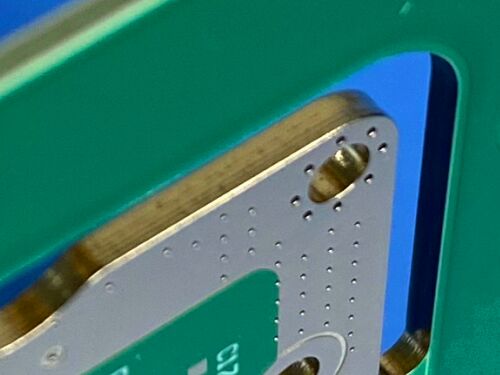
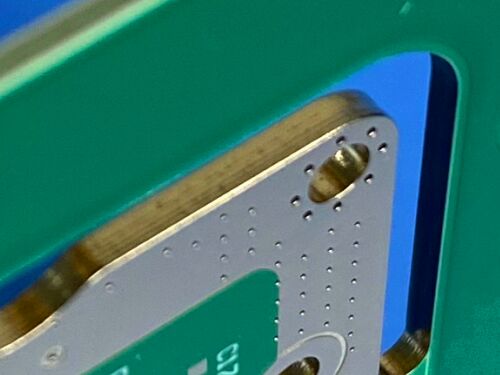
This PCB is an 8-layer copper construction, adopting high-performance material combination and strict manufacturing standards to meet the requirements of high-reliability electronic applications. It features resin-filled and capped vias, edge plating (metal edge wrapping), immersion gold surface finish, and green solder mask with white silkscreen, ensuring excellent signal integrity, thermal performance and mechanical robustness.


PCB Core Specifications

Construction Parameter Specification
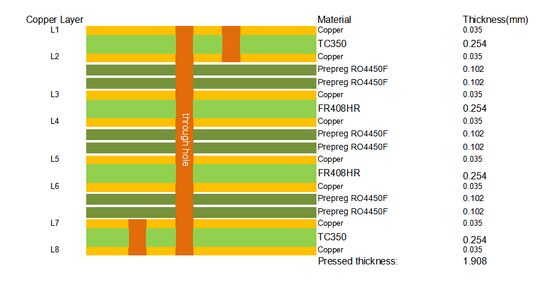
Base Material TC350, FR408HR, RO4450F Prepreg
Copper Layer Count 8 layers
Copper Weight 1oz per layer
Finished Board Thickness 2.0mm
Board Dimensions 99mm × 83mm
Surface Finish Immersion Gold (ENIG)
Solder Mask & Silkscreen Double-sided: Green solder mask and white silkscreen
Via Configuration Blind vias; 0.2mm vias with resin filling and electroplating capping (via filled and capped)
Special Feature Edge plating (metal edge wrapping)


Multilayer PCB TC350 with Blind Vias Edge Plating ENIG Finish 0


Introduction to TC350 Material

TC350 is a fiberglass-reinforced, ceramic-filled, PTFE-based PCB substrate composite, featuring outstanding thermal conductivity (1.0 W/mK) that enhances heat transfer, reduces dielectric and insertion loss, and boosts amplifier/antenna gain and efficiency. It handles higher power, minimizes hot spots, and suits applications with limited thermal management.


TC350 laminates maintain excellent dielectric constant stability (-9 ppm/ºC) across wide temperatures—critical for power amplifiers, antennas, and phase/impedance-sensitive devices. Its low Z-direction CTE matches copper (ensuring plated through-hole reliability), and as a "soft substrate", it resists vibration/impact to meet drop testing standards.


It bonds strongly to microwave-grade low-profile copper (no "toothy copper" needed), further reducing insertion loss at high RF/microwave frequencies. Cost-effective for commercial use, it is easier to drill than traditional laminates and has high peel strength for reliable copper adhesion in thermal stress environments.


TC350 Key Features & Benefits

-"Best in Class" thermal conductivity (1.0 W/mK) and dielectric constant stability across wide temperatures (-9 ppm/ºC)


-Very low loss tangent, providing higher amplifier or antenna efficiency


-Cost-effective for commercial applications


-Easier to drill than traditional commercial laminates with thick, dense woven glass


-High peel strength for reliable copper adhesion in thermally stressed applications


-Excellent heat dissipation and thermal management capabilities


-Improved processing efficiency and overall reliability


-Available in large panel sizes, allowing multiple circuit layouts to reduce processing costs


Multilayer PCB TC350 with Blind Vias Edge Plating ENIG Finish 1


TC350 Typical Applications

-Power Amplifiers, Filters and Couplers


-Tower Mounted Amplifiers (TMA) and Tower Mounted Boosters (TMB)


-Thermally cycled antennas sensitive to dielectric drift


-Microwave Combiner and Power Dividers


Introduction to FR408HR Material

FR408HR is a high-performance FR-4 resin system with a glass transition temperature (Tg) of 230°C (DMA), specifically designed for multilayer PCB applications that require maximum thermal performance and reliability. Manufactured with Isola’s patented high-performance multifunctional resin system, reinforced with electrical grade (E-glass) glass fabric, FR408HR delivers a 30% improvement in Z-axis expansion and offers 25% more electrical bandwidth (lower loss) compared to competitive products in the same category.


The material exhibits superior moisture resistance during reflow processes, bridging the gap between thermal and electrical performance requirements. FR408HR is laser fluorescing and UV blocking, ensuring maximum compatibility with Automated Optical Inspection (AOI) systems, optical positioning systems, and photo-imagable solder mask imaging. It is fully RoHS compliant and offers excellent processing compatibility with standard FR-4 manufacturing processes, making it easy to integrate into existing production lines.


FR408HR Typical Applications

-Multilayer PCBs requiring high thermal performance and reliability


-Lead-free assembly applications


-Electronic devices with dense component layouts (0.8mm pitch capability)


-PCBs requiring AOI compatibility and precise solder mask imaging


-High-reliability electronic systems subject to multiple reflow cycles


What is Via Filled and Capped (Resin Filled and Electroplated Capping)?

Via filled and capped, also known as resin filled and electroplated capping, is a specialized PCB manufacturing process designed to enhance the reliability and performance of vias, especially in high-density, high-speed, and high-reliability applications. This process involves two key steps: resin filling and electroplating capping.


First, the vias (in this PCB, 0.2mm blind vias) are filled with a high-temperature resistant, insulating resin. The resin fills the entire via hole, ensuring that no air gaps or voids remain, which prevents moisture absorption, reduces signal interference, and enhances the mechanical strength of the via. The resin used is typically compatible with PCB lamination and reflow temperatures, maintaining stability during subsequent manufacturing processes.


After the resin is cured, the second step—electroplating capping—is performed. A thin layer of copper (or other conductive metal, matching the PCB’s surface finish) is electroplated over the resin-filled via, forming a smooth, flat cap that is flush with the PCB surface. This cap protects the resin from damage during assembly, ensures electrical continuity (if required), and provides a flat surface for component mounting, which is crucial for high-density PCB designs with fine-pitch components.


The primary benefits of via filled and capped include: preventing solder wicking into vias during assembly, reducing signal reflection and crosstalk in high-speed applications, enhancing thermal conductivity, protecting vias from environmental factors (moisture, dust), and improving the overall mechanical robustness of the PCB.


The Role of Edge Plating (Metal Edge Wrapping)

Edge plating, also referred to as metal edge wrapping, is a PCB manufacturing process that involves plating the exposed edges of the PCB with a conductive metal (typically copper, followed by the same surface finish as the PCB—immersion gold in this case). This process plays a critical role in enhancing the performance, reliability, and manufacturability of the PCB, with the following key functions:


Improved Grounding and EMI Shielding: Edge plating forms a continuous conductive perimeter (Faraday cage), enhancing grounding integrity, reducing external EMI, and preventing internal signal radiation—critical for high-speed, RF, and microwave applications requiring superior signal integrity.


Enhanced Mechanical Strength: It increases PCB mechanical robustness, resisting edge chipping, cracking and damage during handling, assembly and operation, especially suitable for harsh or high-stress environments.


Improved Thermal Dissipation: As an additional thermal pathway, it dissipates component heat, optimizes thermal management, reduces junction temperatures, and extends component lifespan.


Facilitated Electrical Continuity: It enables inter-layer electrical continuity, simplifies grounding design, ensures consistent performance, and reduces edge resistance to improve signal integrity.


Enhanced Solderability and Assembly: Its smooth conductive surface facilitates soldering of edge-mounted components/connectors, boosting assembly reliability and reducing solder joint failure risk.

製品
商品の詳細
Multilayer PCB TC350 with Blind Vias Edge Plating ENIG Finish
MOQ: 1個
価格: USD9.99-99.99
標準パッケージ: 真空袋+カートン
配達期間: 8~9営業日
決済方法: T/T
供給能力: 5000PCS/月
詳細情報
起源の場所
中国
ブランド名
Bicheng
証明
UL, ISO9001, IATF16949
モデル番号
BIC-200.V1.0
基材:
TC350、FR408HR、RO4450Fプリプレグ
レイヤー数:
8層
プリント基板の厚さ:
2.0mm
プリント基板サイズ:
99mm×83mm
銅の重量:
1層あたり1オンス
表面仕上げ:
イマージョンゴールド(エニグ)
はんだマスク:
シルクスクリーン:
最小注文数量:
1個
価格:
USD9.99-99.99
パッケージの詳細:
真空袋+カートン
受渡し時間:
8~9営業日
支払条件:
T/T
供給の能力:
5000PCS/月
ハイライト

Multilayer PCB with ENIG finish

,

TC350 PCB with blind vias

,

Edge plated multilayer PCB

製品説明

This PCB is an 8-layer copper construction, adopting high-performance material combination and strict manufacturing standards to meet the requirements of high-reliability electronic applications. It features resin-filled and capped vias, edge plating (metal edge wrapping), immersion gold surface finish, and green solder mask with white silkscreen, ensuring excellent signal integrity, thermal performance and mechanical robustness.


PCB Core Specifications

Construction Parameter Specification
Base Material TC350, FR408HR, RO4450F Prepreg
Copper Layer Count 8 layers
Copper Weight 1oz per layer
Finished Board Thickness 2.0mm
Board Dimensions 99mm × 83mm
Surface Finish Immersion Gold (ENIG)
Solder Mask & Silkscreen Double-sided: Green solder mask and white silkscreen
Via Configuration Blind vias; 0.2mm vias with resin filling and electroplating capping (via filled and capped)
Special Feature Edge plating (metal edge wrapping)


Multilayer PCB TC350 with Blind Vias Edge Plating ENIG Finish 0


Introduction to TC350 Material

TC350 is a fiberglass-reinforced, ceramic-filled, PTFE-based PCB substrate composite, featuring outstanding thermal conductivity (1.0 W/mK) that enhances heat transfer, reduces dielectric and insertion loss, and boosts amplifier/antenna gain and efficiency. It handles higher power, minimizes hot spots, and suits applications with limited thermal management.


TC350 laminates maintain excellent dielectric constant stability (-9 ppm/ºC) across wide temperatures—critical for power amplifiers, antennas, and phase/impedance-sensitive devices. Its low Z-direction CTE matches copper (ensuring plated through-hole reliability), and as a "soft substrate", it resists vibration/impact to meet drop testing standards.


It bonds strongly to microwave-grade low-profile copper (no "toothy copper" needed), further reducing insertion loss at high RF/microwave frequencies. Cost-effective for commercial use, it is easier to drill than traditional laminates and has high peel strength for reliable copper adhesion in thermal stress environments.


TC350 Key Features & Benefits

-"Best in Class" thermal conductivity (1.0 W/mK) and dielectric constant stability across wide temperatures (-9 ppm/ºC)


-Very low loss tangent, providing higher amplifier or antenna efficiency


-Cost-effective for commercial applications


-Easier to drill than traditional commercial laminates with thick, dense woven glass


-High peel strength for reliable copper adhesion in thermally stressed applications


-Excellent heat dissipation and thermal management capabilities


-Improved processing efficiency and overall reliability


-Available in large panel sizes, allowing multiple circuit layouts to reduce processing costs


Multilayer PCB TC350 with Blind Vias Edge Plating ENIG Finish 1


TC350 Typical Applications

-Power Amplifiers, Filters and Couplers


-Tower Mounted Amplifiers (TMA) and Tower Mounted Boosters (TMB)


-Thermally cycled antennas sensitive to dielectric drift


-Microwave Combiner and Power Dividers


Introduction to FR408HR Material

FR408HR is a high-performance FR-4 resin system with a glass transition temperature (Tg) of 230°C (DMA), specifically designed for multilayer PCB applications that require maximum thermal performance and reliability. Manufactured with Isola’s patented high-performance multifunctional resin system, reinforced with electrical grade (E-glass) glass fabric, FR408HR delivers a 30% improvement in Z-axis expansion and offers 25% more electrical bandwidth (lower loss) compared to competitive products in the same category.


The material exhibits superior moisture resistance during reflow processes, bridging the gap between thermal and electrical performance requirements. FR408HR is laser fluorescing and UV blocking, ensuring maximum compatibility with Automated Optical Inspection (AOI) systems, optical positioning systems, and photo-imagable solder mask imaging. It is fully RoHS compliant and offers excellent processing compatibility with standard FR-4 manufacturing processes, making it easy to integrate into existing production lines.


FR408HR Typical Applications

-Multilayer PCBs requiring high thermal performance and reliability


-Lead-free assembly applications


-Electronic devices with dense component layouts (0.8mm pitch capability)


-PCBs requiring AOI compatibility and precise solder mask imaging


-High-reliability electronic systems subject to multiple reflow cycles


What is Via Filled and Capped (Resin Filled and Electroplated Capping)?

Via filled and capped, also known as resin filled and electroplated capping, is a specialized PCB manufacturing process designed to enhance the reliability and performance of vias, especially in high-density, high-speed, and high-reliability applications. This process involves two key steps: resin filling and electroplating capping.


First, the vias (in this PCB, 0.2mm blind vias) are filled with a high-temperature resistant, insulating resin. The resin fills the entire via hole, ensuring that no air gaps or voids remain, which prevents moisture absorption, reduces signal interference, and enhances the mechanical strength of the via. The resin used is typically compatible with PCB lamination and reflow temperatures, maintaining stability during subsequent manufacturing processes.


After the resin is cured, the second step—electroplating capping—is performed. A thin layer of copper (or other conductive metal, matching the PCB’s surface finish) is electroplated over the resin-filled via, forming a smooth, flat cap that is flush with the PCB surface. This cap protects the resin from damage during assembly, ensures electrical continuity (if required), and provides a flat surface for component mounting, which is crucial for high-density PCB designs with fine-pitch components.


The primary benefits of via filled and capped include: preventing solder wicking into vias during assembly, reducing signal reflection and crosstalk in high-speed applications, enhancing thermal conductivity, protecting vias from environmental factors (moisture, dust), and improving the overall mechanical robustness of the PCB.


The Role of Edge Plating (Metal Edge Wrapping)

Edge plating, also referred to as metal edge wrapping, is a PCB manufacturing process that involves plating the exposed edges of the PCB with a conductive metal (typically copper, followed by the same surface finish as the PCB—immersion gold in this case). This process plays a critical role in enhancing the performance, reliability, and manufacturability of the PCB, with the following key functions:


Improved Grounding and EMI Shielding: Edge plating forms a continuous conductive perimeter (Faraday cage), enhancing grounding integrity, reducing external EMI, and preventing internal signal radiation—critical for high-speed, RF, and microwave applications requiring superior signal integrity.


Enhanced Mechanical Strength: It increases PCB mechanical robustness, resisting edge chipping, cracking and damage during handling, assembly and operation, especially suitable for harsh or high-stress environments.


Improved Thermal Dissipation: As an additional thermal pathway, it dissipates component heat, optimizes thermal management, reduces junction temperatures, and extends component lifespan.


Facilitated Electrical Continuity: It enables inter-layer electrical continuity, simplifies grounding design, ensures consistent performance, and reduces edge resistance to improve signal integrity.


Enhanced Solderability and Assembly: Its smooth conductive surface facilitates soldering of edge-mounted components/connectors, boosting assembly reliability and reducing solder joint failure risk.

地図 |  プライバシーポリシー | 中国 良い 品質 RF PCB板 提供者 著作権 2020-2026 Bicheng Electronics Technology Co., Ltd すべて 権利は保護されています.